[September 17, 2026]
Defense Autonomy Needs to Train, like Humans, In Simulation
Author: Seb Lozé, Director of Market Innovation and Ecosystems
This blog is part of a series exploring the technologies and principles shaping the future of simulation.
A program office asks a fair question about an autonomous aircraft. How will it learn to handle a specific threat, in a specific place, against a specific sensor picture, when its link to the operator drops? Not in a demonstration. In the conditions the mission will actually present.
The honest answer is that the data required to teach that does not exist yet.
That answer sits strangely against everything the public conversation about AI suggests is now possible. It is worth being precise about why, because the systems driving that conversation were built on a very different problem.
Consider an example from well outside defense. A few weeks ago I asked an image model to show my mother’s dog in a ballerina outfit. No such photograph exists, and nobody in my family could have described one. The result was good enough that I kept it, and my mother laughed for a week.
Nothing about that is trivial. It is Generative AI inference. The AI model has absorbed an enormous amount of what people have photographed, drawn, written, and filmed, and from all of it, it predicts a convincing next image. The same mechanism lets a chat model continue a story you started. Human creativity, gathered at internet scale, is the raw material, and the results are genuinely useful.
Apply that same approach to a military mission, however, and the underlying conditions are very different.
The Internet Has No Data for Your Mission
Get specific about a task, threat, sensor, geography, or rule of engagement, and data scarcity quickly becomes the constraint. What exists is often classified, held by one nation, or generated so rarely that no one has enough of it. A model cannot infer its way to competence in a contested electromagnetic environment from data that was never collected.
The objective inverts too. Creativity is what makes the ballerina dog delightful. It is not what an operator wants from an autonomous teammate at low altitude with a degraded datalink. Operators want behavior that is predictable, bounded, and explainable afterward.
So autonomy for defense meets a supply problem before it meets an algorithm problem. The autonomy system still has to accumulate experience somewhere. Repetitions, rare conditions, edge cases, and their consequences. The publicly accessible data corpus does not provide them.
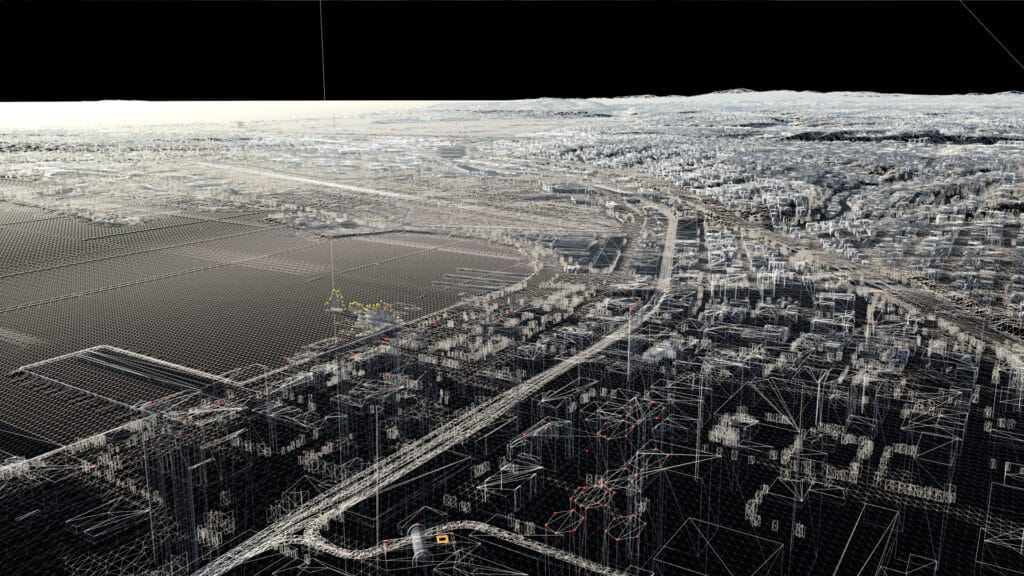
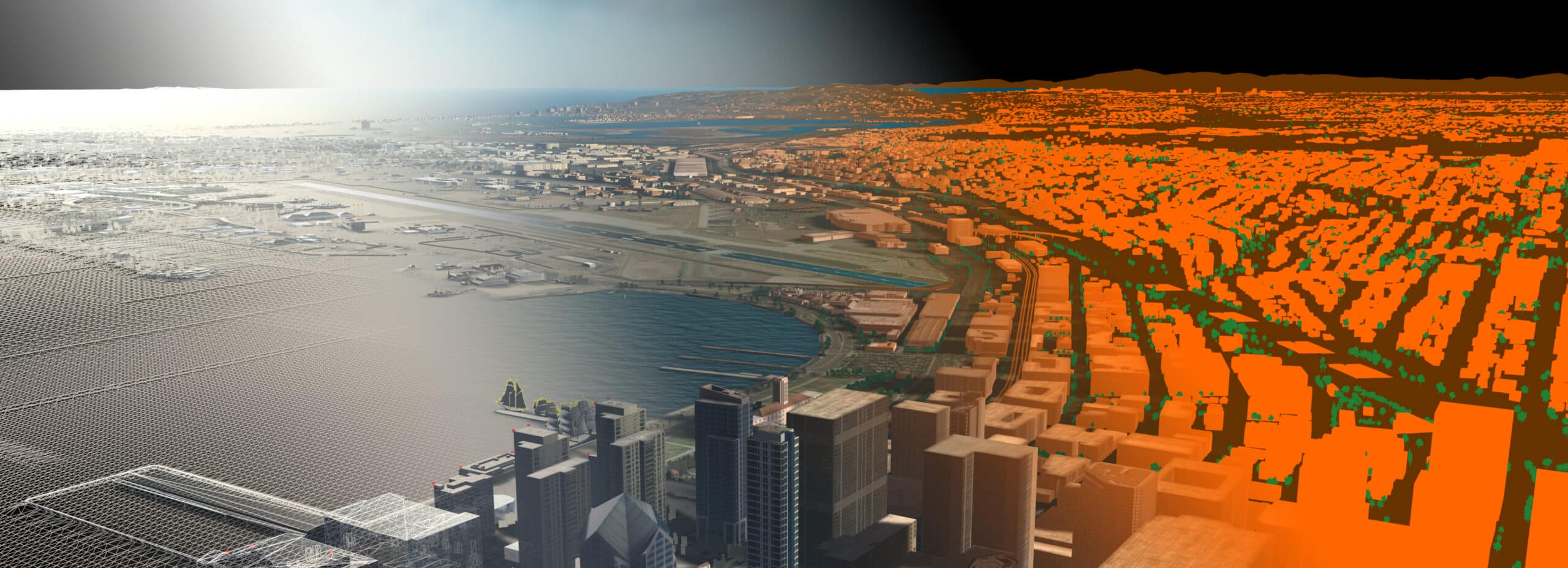
Wireframe view of a synthetic environment, showing the terrain and structural geometry the rendered scene is built on.
Simulation Has Been Solving the Experience Problem for Nearly Three Decades
The simulation community has been solving a version of that problem since long before autonomy was the question.
For nearly three decades, people in uniform and in industry have digitized terrain, atmosphere, sensors, dynamics, and interaction well enough that aircrews would train against it and trust the result with their lives. Rare incidents, degraded conditions, and threat maneuvers that almost never appear in live training became repeatable on demand.
The simulation community also built the part that gets overlooked. Verification, Validation, and Accreditation (VV&A) exist so that trust in a simulated environment is tested and documented before a program depends on it. Interoperability standards let systems built by different teams, on different architectures, take part in the same exercise and share one consistent picture of what is happening in it. Decades of coalition exercises, standards development, and accreditation have created a mature approach to generating and evaluating trusted simulated environments.
The simulation community has built a mature discipline for generating mission relevant experience. Those methods and best practices can now become part of the foundation for defense autonomy.
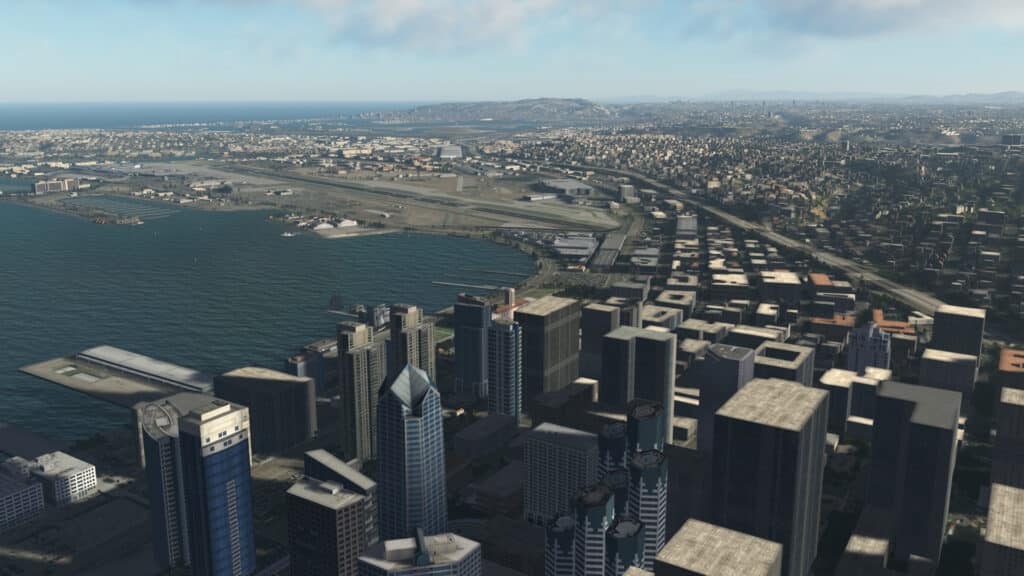
The same database rendered as a trainee pilot sees it, at the fidelity aircrews have trained and been evaluated against for nearly three decades.
Simulation and AI Make Each Other Stronger
Look at what a simulation team does on an ordinary day. It generates terrain and operational conditions. It produces imagery and physically grounded sensor returns across visual, infrared, and radar. It runs scenarios faster than real time, many times over, with controlled variation. It captures what happened for after action review.
Every one of those outputs is a potential input an AI model needs and cannot easily get elsewhere. Synthetic data generation, image generation, sensor effects, high volume scenario execution, and structured review tooling were built to prepare people. They also produce annotated, consistent, mission relevant experience at a volume real world collection cannot approach.
The exchange runs in the other direction as well, and that part deserves more attention than it usually gets. Building synthetic environments is labor intensive. Correlating a database across visual and sensor domains, populating a region, authoring behaviors, and tuning a scenario all take skilled human hours. AI is already reducing that load in content production, scenario generation, and the analysis of what an event produced, surfacing an anomaly in a run that a reviewer would have spent hours finding.
AI can make simulation easier to build and analyze. In turn, simulation can provide the controlled experience autonomous systems need to learn and be evaluated.
The synthetic environment content creation expertise from Aechelon is a great example of how these simulation pipelines can serve both human training and become the data source of the AI factories of tomorrow.
Humans and Autonomous Systems Can Train Together
The next step is where training programs get real value. One environment, two kinds of learners.
A pilot needs perceptual realism, progressive difficulty, doctrine represented faithfully, and the ability to fail safely. An AI model needs volume, controlled variation, deliberate edge cases, repeatability, and evidence a reviewer can inspect.
What they share is the mission context. Physics and causality that resolve the same way every time. Sensor effects that behave consistently. Measurable and explainable outcomes. Operational relevance. A governed and traceable representation of that context lets each participant receive a different view, at a different resolution or classification, while the program can still trace those views back to one authoritative source and explain the differences.
That shared mission context creates the foundation for manned-unmanned teaming. In simulation, operators can practice coordinating with autonomous systems while programs evaluate how each responds to the same conditions and how they perform as a team. Repeated scenarios expose gaps in coordination, decision-making, and behavior before they affect operational performance.
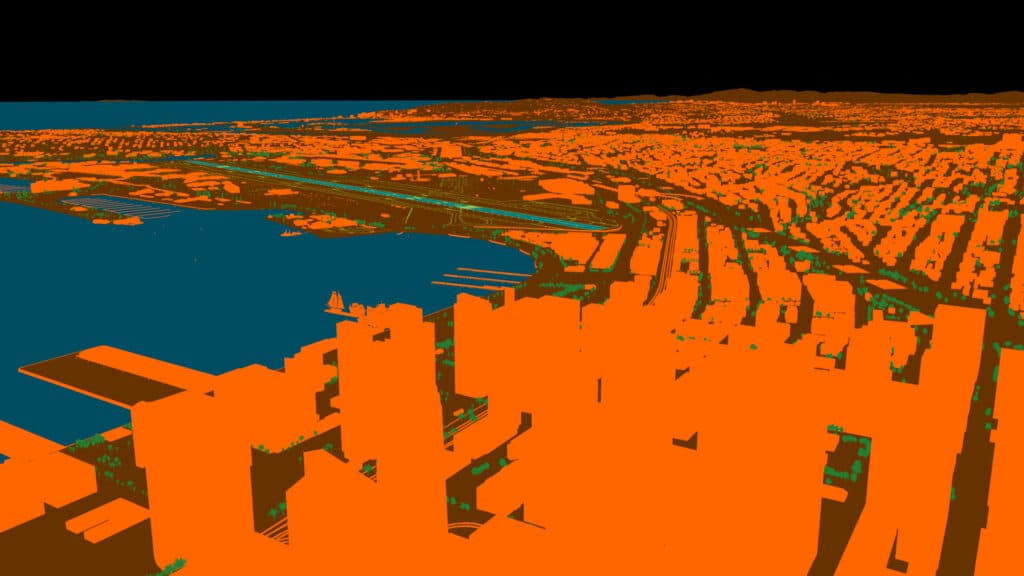
The same database again, rendered as classified and labeled surfaces, which is the form an AI model consumes to learn from it.
The Rigor Used to Train Humans Must Now Prepare Autonomous Systems
Rigorous simulation best practices were built to make human training environments trustworthy. They now provide the practical basis for autonomous system readiness and for preparing manned-unmanned teams.
Simulation is not being replaced by AI. It gains a second mission alongside the first one. It builds and sustains human skill, generates the virtually unlimited training data autonomous systems need, and produces the evidence programs need to trust them. Those same methods allow programs to evaluate the operator, the autonomous system, and the performance of the team as a whole.
There is a harder question underneath all of this. If the environment is where both humans and machines learn, then whoever controls the data, models, and assumptions behind it holds real authority over readiness. The next article in this series looks at sovereignty as a training architecture requirement.
About the Author:
Seb Lozé is Director of Market Innovation and Ecosystems at Shield AI. He brings more than 20 years of experience in simulation and training, with a focus on advancing real-time 3D technologies for defense and aerospace.