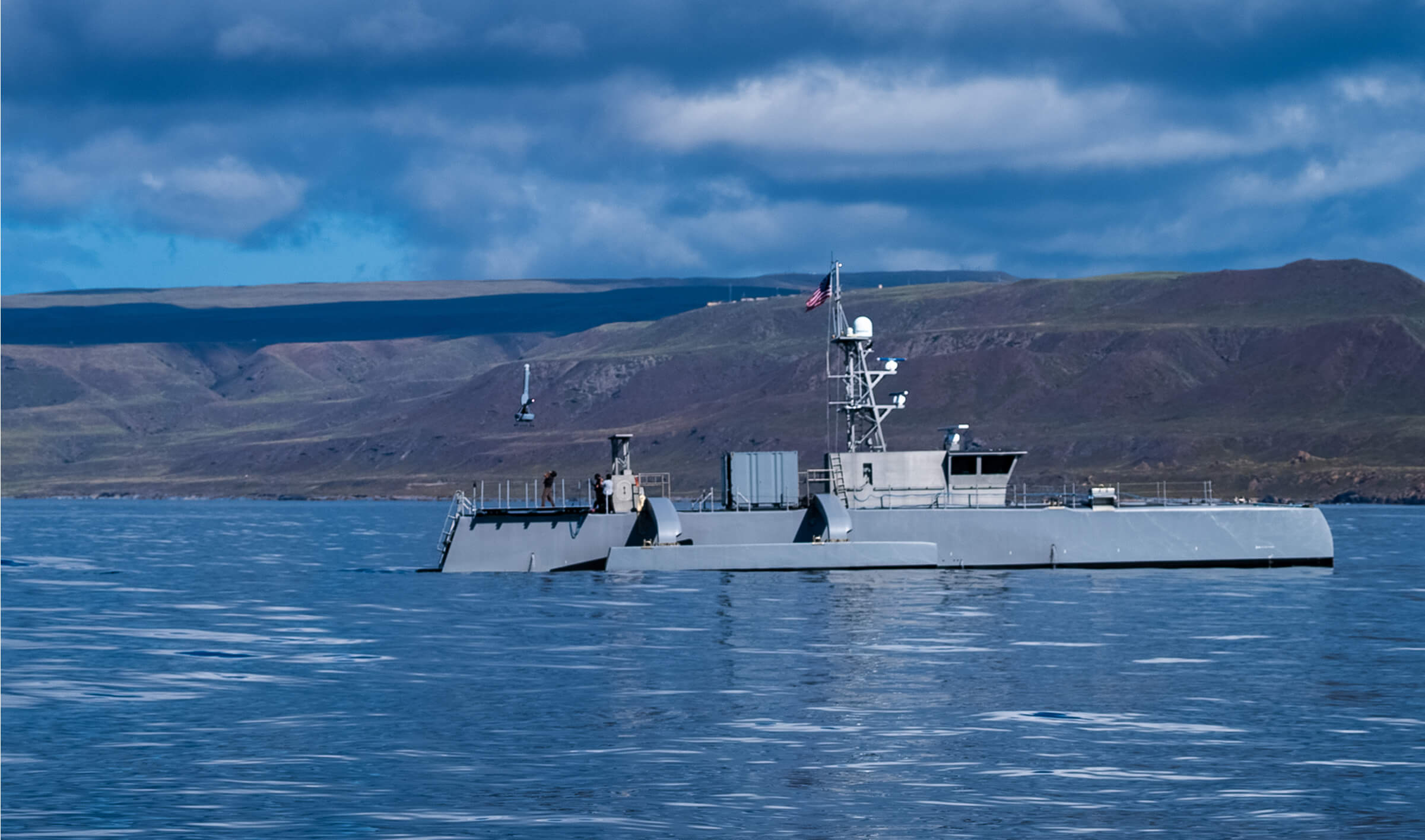
As an island nation, maritime awareness is essential to Taiwan’s national security. Its coastline stretches more than 1,500 kilometers across the main island and outlying islands, so keeping watch over the surrounding waters requires vessels, sensors, and operators spread over a wide area. Autonomous unmanned surface vehicles (USVs) can extend surveillance, but adding more USVs also means operators spend more time telling each vessel what to do.
Hivemind is Shield AI’s mission autonomy software that enables unmanned systems to see, think, and act with minimal human input. Most autonomous USVs today focus on individual platform functions, such as navigating along a predefined route, but Hivemind is different. Hivemind is built to manage the mission itself, including how multiple vessels work together as conditions change.
Shield AI and Thunder Tiger Corp., a Taiwan-based manufacturer of unmanned systems, partnered to demonstrate this capability, integrating Hivemind aboard Thunder Tiger’s SeaShark 600 and SeaShark 800 USVs.
This case study outlines how Shield AI:
- Progressed from initial software integration to a live maritime demonstration in only six weeks
- Enabled autonomous multi-USV teaming with Hivemind
- Established a path to expand maritime ISR coverage without increasing operator workload
“We sought out the world’s strongest technology: Shield AI’s Hivemind. We chose them because we know they have already integrated and tested on 30+ platforms.” – Bryan L., Thunder Tiger USV Division Lead
From simulation to sea trials in six weeks
Hivemind’s modular, open architecture allowed Shield AI and Thunder Tiger to build on software and experience from dozens of previous platform integrations. That gave the teams a head start in bringing mission autonomy to the SeaSharks. Before taking the SeaSharks onto the water, the teams started their work in simulation. Shield AI engineers used digital representations of the SeaShark 600 and SeaShark 800 to develop mission behaviors before operating the physical USVs. In parallel, the teams prepared Hivemind’s interfaces with the vessels’ systems and sensors, then advanced to vehicle-in-the-loop testing to test the autonomy with the vessels’ actual hardware.
The live demonstration showed that the same autonomy architecture could manage assignments across two different SeaShark models. The six-week effort also established a repeatable path for integrating Hivemind aboard other USVs.

Building a shared maritime picture
The ISR demonstration was a shared patrol mission in Dapeng Bay. To start, Shield AI and Thunder Tiger mission planners divided the patrol area into two sections and assigned one SeaShark to each. Both USVs used maritime radar and Automatic Identification System (AIS) data to monitor their surroundings.
Mission planners then directed a third boat into the patrol area as the “vessel of interest.” To coordinate their response, the SeaSharks needed a consistent picture of the vessel’s location and movement.
Building that picture required combining information from different sources. Radar aboard the SeaSharks detected the vessel of interest and estimated its position, while AIS broadcasts from the vessel provided identity and location information. Because radar and AIS update at different rates, they typically report slightly different positions for the same boat.
Hivemind reconciled the two data sources by comparing the vessel’s reported position and movement over time. It determined which reports described the same boat, then fused them into a single track: a continuously updated estimate of the vessel’s position and movement. Hivemind shared that track across both SeaSharks so they could follow the same vessel as it moved through the patrol area.
Meanwhile, the SeaShark 600’s electro-optical/infrared (EO/IR) sensor provided live video of the vessel of interest to operators ashore. With both SeaSharks following the same vessel and operators receiving live video, the autonomous team was ready to shift from patrol to coordinated observation.
Switching the mission in real time from ‘Patrol’ to ‘Escort’
Once the SeaSharks established a shared track of the vessel, the next task was to keep it under observation as it moved through the patrol area. Hivemind temporarily suspended the SeaSharks’ patrol assignments and initiated a higher-priority Escort behavior. In this mission, “escorting” meant accompanying the vessel of interest to maintain continuous observation of its movement and activity.
Hivemind assigned one SeaShark to the vessel’s port side and the other to its starboard side. These positions gave operators complementary views through full-motion video and placed the USVs in position to support interdiction if directed.
After the vessel of interest left the patrol area, Hivemind ended the escort and directed both SeaSharks back to their assigned sectors. The vessels resumed the original mission without requiring the operator to rebuild the patrol plan or manually reposition each USV.

Simulation shows five Hivemind-enabled USVs could cover 8× more water
Adding more vessels can extend maritime coverage, but it can also create more information for operators to manage. Mission autonomy allows that fleet to grow without requiring operators to direct every movement.
This becomes increasingly valuable across a larger operating area such as the Taiwan Strait. A fleet cannot monitor every part of that area continuously, so commanders must use available USVs efficiently. When a potential vessel of interest appears, Hivemind can direct a USV to investigate and adjust the assignments of the remaining vessels. Operators can then focus on deciding which vessels require attention and how to respond.
To explore the potential at a larger scale, Shield AI engineers modeled how Hivemind could expand maritime surveillance coverage. In the simulation, five USVs using adaptive mission autonomy covered a 50-nautical-mile stretch, compared with 6 nautical miles for five USVs using fixed patrol patterns. Both maintained a 95% vessel identification rate. That represents roughly 8.3 times the coverage with the same number of vessels. Actual coverage depends on sensor performance, vessel speed, and operating conditions, but the analysis illustrates how Hivemind could help a fleet monitor more water with the vessels it already has.
“We are very optimistic about Hivemind, which brings autonomy to USVs for area search, target tracking, and the execution of these missions.” – William Chen, Thunder Tiger Chairman
A path to wider maritime coverage
Taiwan has a vast stretch of surrounding water to monitor. Autonomous USVs can extend surveillance, while mission autonomy helps them work together to understand what’s happening across it. Vessels can share observations and adjust their patrols to investigate activity that needs a closer look.
Paired with Taiwan’s domestic USV manufacturing capabilities, Hivemind offers a path to get more surveillance capability from the vessels it fields. Dapeng Bay demonstrated the foundation: USVs coordinating a shared mission and adapting together as conditions changed.
For Taiwan and other countries with extensive coastlines, this opens a path to fleets that carry out more of the mission themselves, freeing operators to focus on decisions that need human judgment.
The result is broader coverage and a clearer picture of what’s happening at sea.