[June 25, 2026]
The Missing Layer in Maritime Autonomy
Author: PJ Folino (Principal Product Manager, Hivemind)

When most people think of the Coast Guard, they probably imagine daring rescues like you see in the movies—hopefully helicopters flying through hurricanes, like in The Perfect Storm, though for many people, it’s probably just the five seconds we appear in Top Gun. While it may be the “forgotten service” from time to time, the Coast Guard punches far above its weight class. Beyond search and rescue missions, there is another side of the Coast Guard focused on facilitating global commerce and preventing those situations from happening in the first place—or as we like to say, “keeping mariners safe from the sea, and the sea safe from mariners.” Over the course of my 16-year Coast Guard career, including several years as a marine inspector, I have been fortunate enough to play a small role in that Prevention mission, ensuring both domestic and foreign-flagged vessels—from small passenger ferries to oceangoing cargo ships nearly a quarter mile long—are safe to proceed to sea.
The ocean remains the world’s biggest blind spot for illicit activity
Through that experience, I’ve had a front-row seat to the global maritime transportation system that quietly carries the vast majority of world trade and to the mariners from every corner of the globe who keep it running every day. Most of that activity is routine. Containers move, fishing vessels fish, and tankers deliver fuel. But beneath that normalcy exists a harder reality few people ever see—smuggling, illegal fishing, piracy, forced labor, and gray-zone actors exploiting the vastness of the ocean and the noise of global commerce to avoid scrutiny—or what investigative journalist Ian Urbina refers to as the “outlaw ocean.”
USVs expand visibility at sea, but autonomy still falls short of real-time judgment
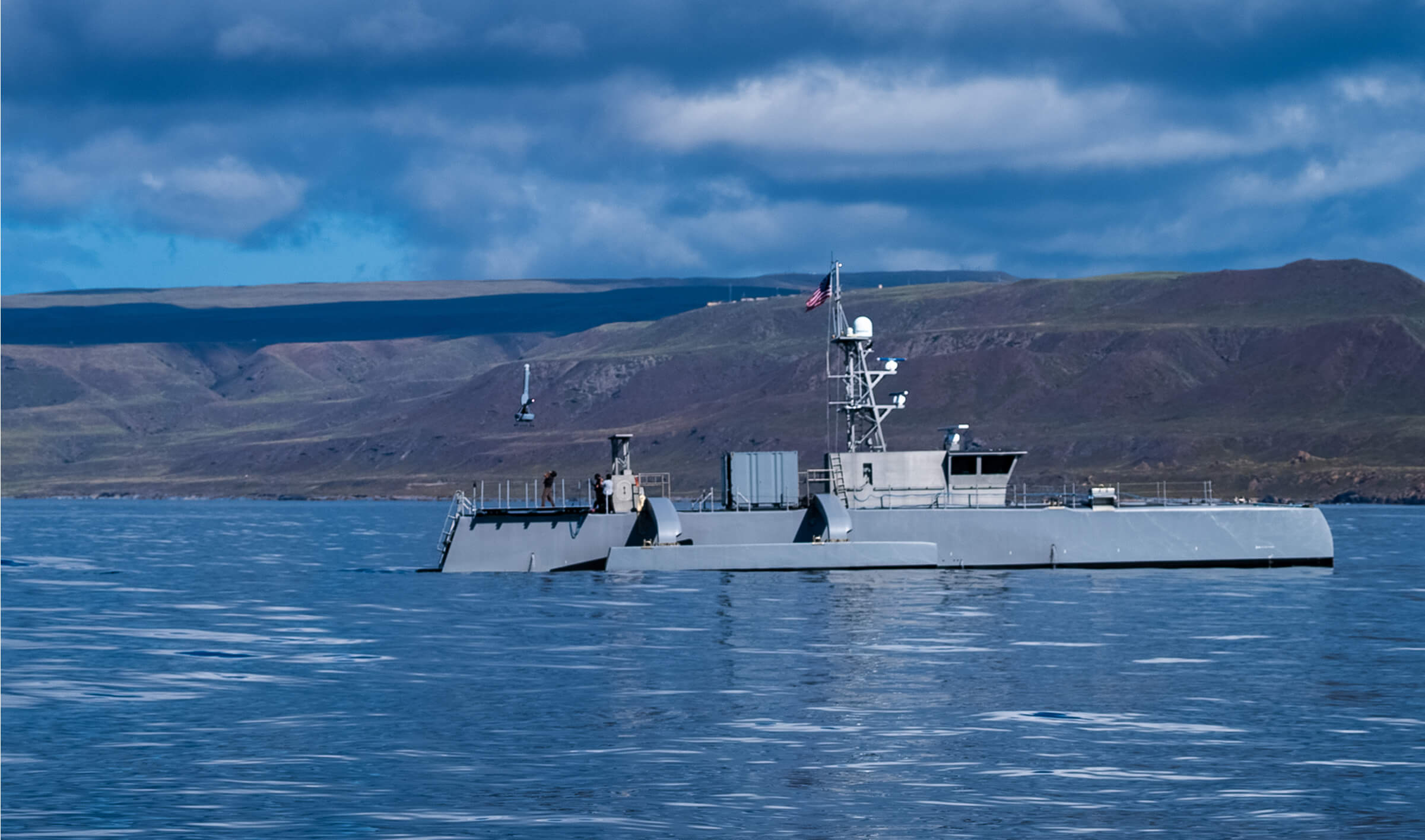
In response to these maritime blind spots, which increasingly impact the sovereignty, stability, and lifeblood of seafaring nations, private industry has invested heavily in designing and manufacturing unmanned surface vessels (USVs) to expand maritime domain awareness (MDA) at lower cost and greater scale. After all, you can’t stop what you can’t see. A market once dominated by a handful of primes and a few specialized manufacturers (OEMs) has rapidly evolved into a growing ecosystem delivering persistent intelligence, surveillance, and reconnaissance (ISR) at lower operational costs than traditional crewed assets. And frankly, that’s a good thing. Advances in sensors, SATCOM, and battery technology have lowered the barriers to entry for many of these OEMs, allowing platforms of every size and configuration to compete and deliver increasingly capable solutions to important end-users in the U.S. Navy, U.S. Coast Guard, and international partners. Despite this surge in innovation, much of the industry remains focused on hardware and the lower-level software autonomy needed to move it, such as waypoint navigation, remote piloting, collision avoidance, and rules-based autonomy. These are useful capabilities, but the maritime domain is not static. It demands systems with the onboard judgment of a ship CO or small boat coxswain that can adapt in real time to ambiguity, evolving intelligence, and rapidly changing conditions—more like an improv actor than a scripted performer.
Maritime autonomy collects more data than humans can typically interpret or act on
Today’s maritime autonomous systems are exceptionally good (or at least getting much better) at collecting data, but they are far less effective at understanding what actually deserves attention. Without a real understanding of operator intent or mission relevance, systems tend to collect everything, often indiscriminately and with little prioritization. The result is a flood of radar tracks, AIS hits, and imagery—what many operators call “spaghetti tracks”—with little operational context behind them. Because the overwhelming majority of maritime activity is benign, the burden of determining what actually matters still falls heavily on the human operator, forcing watchstanders to manually sort signal from noise in real time. By the time a true contact of interest is picked from the pile, the operational window has often already closed, and the vessel has slipped beyond sensor coverage or blended back into the background of normal maritime traffic. The result is a maritime ISR ecosystem increasingly optimized for detection, but far less effective at helping operators rapidly identify, understand, and act on the contacts that actually matter.

Source: MarineTraffic.com
Despite advances in autonomy and AI, part of the reason we continuously miss bad actors is because many of today’s USVs still operate with yesterday’s software. For their customers, OEMs deploy remotely operated picket lines or scripted patrols across high-risk maritime corridors that “catch what they catch,” but often lack the onboard judgment needed to dynamically adapt collection and maneuver against the vessels that operators care about. If an end-user is searching for pangas in the Caribbean and a USV captures a grainy image of a small vessel on the horizon, the system often has no way to autonomously maintain custody of the contact, reposition sensors, or systematically build confidence in who the vessel is and what it is doing. If the operators want to investigate further, they are often dependent on a remote pilot to re-task and maneuver the USV—by which point the contact has often already disappeared back into the noise.
While the growth of USV adoption across the sea services is encouraging, there remains a significant gap between collecting maritime ISR data and achieving meaningful mission outcomes from it. Closing that gap requires a new layer of software autonomy that sits between how the platform moves and the operator’s intent.
Hivemind mission autonomy enables coordinated, intent-driven maritime ISR at scale
Hivemind is Shield AI’s mission autonomy layer designed to close the gap and drive more successful mission outcomes for navies and coast guards. We’re starting to see this shift emerge through our work with forward-leaning maritime partners who recognize that the future value of maritime autonomy will come not just from individual platforms, but from enabling dozens or hundreds of autonomous systems to coordinate, prioritize, and execute missions like ISR at scale. Instead of forcing maritime end-users to babysit individual platforms—a paradigm that quickly breaks down when there are more drones than people—or manually analyze overwhelming amounts of ISR data to determine what matters, Hivemind pushes that intent directly into the autonomous USV team itself. In practice, that means end-users define what they care about—pangas in the Caribbean, distant-water fishing vessels in the Eastern Pacific, or suspicious dhows in the Gulf of Oman—while a Hivemind-enabled USV team handles much of the higher-level mission planning and tactical execution required to collect on those contacts.

Source: Ops Analysis graphic from Akshay Kadhiresan, Staff Engineer at Shield AI
So, revisiting the earlier example, if maritime operators prioritize identifying pangas in the Caribbean and a USV captures that same grainy image of a small vessel on the horizon, the system could autonomously build confidence in the contact instead of waiting for operators to manually direct every next step. The autonomous team can then reposition to maintain custody of the vessel, cue nearby USVs or UAVs for closer interrogation, fuse track data across platforms and domains, and dynamically adapt collection as understanding builds around what the vessel is, where it is going, and whether it is operationally relevant. Rather than treating ISR as a series of disconnected, human-directed tasks, the system treats the maritime domain as a continuously evolving information problem to solve in real time, allowing autonomous systems to work alongside operators instead of against them.
The future of maritime autonomy is autonomous mission execution
The USV industry is still in the early innings. Over the next decade, the number of USVs and other autonomous systems operating across the maritime domain will grow dramatically as navies, coast guards, and commercial operators push for greater persistence, broader coverage, and lower operational costs. But simply deploying more autonomous platforms will not solve the underlying problem; there are not enough operators in the world. Without mission autonomy, operators will continue to drown in low-value irrelevant detections, manually orchestrate disconnected systems, and struggle to convert high volumes of maritime ISR data into meaningful operational outcomes.
The next phase of maritime autonomy will not be defined solely by which platform can stay at sea the longest or carry the best sensor suites (though both remain important problems to solve); it will be defined by which systems can best understand operator intent, dynamically prioritize what matters, and coordinate and optimize sensing resources across platforms and domains to reduce uncertainty in real time and at low cost. Hivemind is purpose-built for exactly this challenge — delivering resilient, edge-native intelligence that scales from a single USV to a distributed fleet and enabling operators to supervise and direct that fleet at the mission level rather than the vehicle level.
But the real force multiplication comes when maritime autonomy does not operate in isolation. Modern operations increasingly require USVs, airborne assets, and human operators to share information, coordinate sensing, and maintain a common understanding of the environment. Hivemind was built with this in mind. The same autonomy stack that powers mission execution across air and weapons systems can be applied to maritime platforms, enabling teams of autonomous systems to coordinate actions, share tracks, and support operator decision-making across domains. As Shield AI expands Hivemind’s maritime capabilities, we are building on a foundation of proven multi-agent autonomy and multi-domain collaboration rather than starting from scratch.
In other words, the future of maritime autonomy is not about autonomous boats. It is about autonomous mission execution. It’s a future we’re excited to help build at Shield AI.
The oceans—and the people, commerce, and security challenges tied to them—demand nothing less.
About the Author:
PJ Folino is a Principal Product Manager at Shield AI, where he focuses on scaling Hivemind – Shield AI’s autonomous AI pilot – across maritime autonomous vehicles. Prior to Shield AI, PJ worked at Saildrone, leading maritime software and hardware products and previously at C3 AI, where he managed C3 AI Readiness, an AI-based predictive maintenance platform now a system of record used by the U.S. Air Force. Before transitioning into product management, PJ served nine years active duty in the U.S. Coast Guard and continues to serve as a Commander in the reserves. He holds engineering degrees from the U.S. Coast Guard Academy and MIT, an MBA from NYU Stern, and is a licensed professional engineer in Washington, D.C. He is also a Term Member on the Council of Foreign Relations. Recently relocated to San Diego, PJ spends most of his free time chasing his two young kids around the beach with his wife.